CAN YOU COMBINE AEROBIC CONDITIONING WITH STRENGTH AND RESISTANCE TRAINING
FITNESS HOME GYMS THAT PROMISE IT ALL
MINIMAL EFFORT FOR MAXIMUM GAIN. Advertising companies use this theme to promote their new fitness apparatus, fitness products that promise the benefits of both strength training and aerobic training in one workout — with minimum time investment. Although heart rates are elevated on these machines, it’s important to realize that elevated heart rates alone are not direct indicators of an aerobic training stimulus.
This article will illustrate why resistance training is not physiologically effective as an aerobic training method, and why the majority of home gyms have limited effectiveness in increasing VO2max. The relationship between heart rate and oxygen consumption necessary for maximum aerobic benefit and the corresponding heart rate/oxygen relationship during resistance training will be examined. In addition, the pressor response, which may help you understand why these differences occur, will be examined.
Heart rate, oxygen consumption and aerobic benefit
The American College of Sports Medicine recommends that to improve cardio-respiratory endurance most effectively, an exercise must utilize large muscle groups, must be rhythmic in nature and must be sustained for a minimum period — usually 20 to 30 minutes. In addition, the exercise intensity should be between 40 and 85 percent of an individual’s functional capacity.
During aerobic exercise, heart rate is a good indicator of how hard a person is working. There is a proportionate increase in heart rate as energy demands of the exercise increase. The working muscles need more oxygen and fuel, so heart rate and stroke volume must increase to provide more blood to the tissues to meet the increased metabolic needs of the muscles. It is this degree of metabolic overload that taxes the cardio-respiratory system and provides the stimulus to improve VO2max.
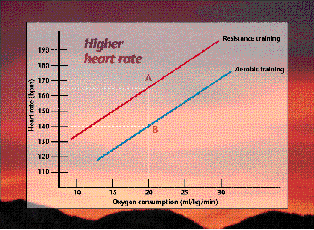
Figure 1.
At any given level of oxygen consumption, HRs are much higher during resistance training compared to aerobic training. For example, this panel indicates that at an oxygen consumption of 20 ml/kg/min, resistance training elicits a HR of 165 bpm (point A), compared to a HR of 140 bpm for aerobic training (point B).
During resistance training, on the other hand, heart rate is disproportionately elevated relative to oxygen consumption. This concept is illustrated in Figures 1 and 2 which compare the HR/VO2 relationship for both resistance and aerobic training. Figure 1 shows that at any given level of oxygen consumption, heart rates are much higher for resistance training than for aerobic conditioning. Thus, even though heart rates are increased during resistance training, the oxygen consumption is not increased to the same degree as it is during aerobic conditioning. This minimizes the metabolic overload to the muscles and, thus, limits the aerobic training benefit.
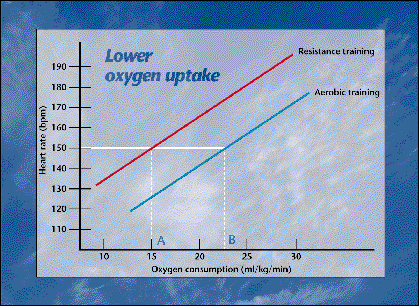
Figure 2.
At any given HR, the oxygen cost or metabolic overload is much lower for resistance training compared to aerobic training. For example, this panel illustrates that at a HR of 150, the oxygen consumption during resistance training is 15 ml/kg/min (point A), compared to 22.5 ml/kg/min for aerobic training (point B).
Figure 2 illustrates the same principle but from a different perspective. Figure 2 shows that at any given heart rate, the metabolic overload (oxygen cost) to the system is much lower for resistance training when compared to aerobic training. In fact, studies have found that at any given heart rate, VO2 during strength training averages only 68 percent of that seen during aerobic training. Again, this figure illustrates the difference between the training methods and their effect on aerobic conditioning.
The pressor response
To understand the factors that limit aerobic benefits during strength training, it is necessary to understand a phenomenon called the pressor response. The term pressor response refers to the collective cardiovascular responses (heart rate and blood pressure) which occur reflexively from the contraction of skeletal muscle. The pressor response helps to explain, from a physiological standpoint, why the heart rate is disproportionately elevated relative to oxygen consumption during resistance training.
During strength training, there are three main factors that govern the intensity of the pressor response, and these factors are responsible for the differences in the cardiovascular responses to exercise. These factors are: 1) the level of central command, 2) intramuscular compression in the working muscles and 3) vasoconstriction in the non-working muscles.
Level of central command
The term “central command” refers to stimulation of the cardiovascular center in the brain, which is based on the magnitude of the skeletal muscle activity. When the brain sends impulses to the working muscles, it also sends a proportionate number of impulses to the cardiovascular center in an attempt to match heart rate and blood pressure responses with what is occurring in the working muscles.
This activation is proportional to the percentage of maximal strength (percent MVC) at which the muscle or muscle group is contracting. It is not necessarily related to the mass of active muscle or the metabolic needs of the muscles. During high-resistance strength training, a large number of muscle fibers are being recruited and are firing rapidly. This results in a high degree of central command with a corresponding cardiovascular response.
During aerobic exercise, on the other hand, large muscle groups are being used, but usually are not contracting at a high percentage of MVC. Therefore, the cardiovascular responses are dictated by, and are more in line with, the metabolic needs of the muscles.
Intramuscular compression in the working muscle
The second factor affecting the pressor response relates to the degree of intramuscular compression as the muscles contract. During all types of lifting activities, as the muscles contract they exert mechanical compression on the vessels leading into and out of the working muscles. Thus, fresh blood has difficulty entering the tissue beds, and waste products are not as easily removed.
As waste products build up, they stimulate the peripheral nerve endings within the working muscles, which, in turn, feed back to the cardiovascular center in the brain to regulate (via sympathetic stimulation) hemodynamic responses appropriately. The build-up of waste products is greatest during purely isometric exercise (since the intramuscular compression is constant), but also occurs during all lifting type activities, when a significant amount of force is being exerted. Thus, during resistance type activities, heart rate and blood pressure responses are mediated by a nervous reflex related to waste product build-up, and are not being regulated specifically by the metabolic needs of the muscles.
Vasoconstriction in non-working muscles
The third contributing factor to the pressor response relates to the degree of vasoconstriction present in the non-working muscles. When an individual exercises, blood vessels in the working muscles vasodilate. At the same time, sympathetic stimulation causes vasoconstriction in the non-active tissue in an attempt to divert blood to where it is most needed.
Resistance training generally involves a relatively smaller muscle mass involvement when compared to aerobic activities. As a result, the amount of non-working tissue that is vasoconstricted is relatively larger during resistance training compared to aerobic training. This vasoconstriction increases the resistance to which the heart must pump against, so stroke volume usually falls. To maintain a constant cardiac output, heart rate must increase disproportionately to compensate for the drop in stroke volume.
Indicators of the pressor response
Pressor response during exercise can be measured by something called the oxygen pulse. Oxygen pulse is defined as the amount of oxygen delivered per heart beat (ml O2/beat). It is considered to be both an indirect measure of stroke volume, as well as a measure of how aerobic the exercise is.
When heart rates are elevated disproportionately relative to VO2, it reflects an attempt by the body to maintain a constant cardiac output in the face of increased vascular resistance. This increased vascular resistance makes it harder for the heart to eject blood, and stroke volume drops. Therefore, low oxygen pulse values mean that less blood and oxygen are being delivered per heart beat, and the system is not operating at an efficient level. When oxygen pulse values are high, it indicates that a great deal of blood and oxygen are being delivered to the tissue with each heart beat (i.e., a high stroke volume). Not surprisingly, oxygen pulse values are highest during traditional aerobic activities such as walking, running and cross-country skiing, and lowest during purely isometric exercise. Oxygen pulse values would be between these two extremes for resistance training.
Resistance training and changes in aerobic capacity
The relationship between resistance training and changes in aerobic capacity is best illustrated in a classic study by Hurley et al., which appeared in Medicine and Science in Sports and Exercise (16: 483-488, 1984). In this study, a group of 13 untrained men completed a 16-week, high-intensity strength-training program using exercise machines. Subjects exercised three to four days per week and performed a total of 14 upper- and lower-body exercises. Overall strength improved by an average of 44 percent, but VO2max did not increase. This occurred despite the fact that subjects moved as quickly as possible between stations and kept exercise heart rates relatively high.
In an attempt to explain the lack of change in aerobic capacity, the authors compared the acute effects of completing the circuit with walking on a treadmill at a comparable VO2. The results of their findings support the physiological mechanisms discussed previously.
The researchers found that the average VO2 during the exercise circuit was 18 ml/kg/min, and heart rate was 155 bpm. When these same subjects walked on a treadmill at the same oxygen consumption level, heart rate was only 115 bpm. The heart-rate response during the circuit represented 80 percent of maximal values, but the metabolic overload was only 45 percent of the subject’s maximum. This is at the lower end of the ACSM recommendations, and was not sufficient to improve cardiorespiratory function in the group of subjects. Oxygen pulse values were 10 ml O2/beat for exercise machine workouts and 14 ml O2/beat for walking, providing further evidence that heart rates during strength training were artificially high relative to the metabolic needs of the muscles.
In the same study, Hurley and his colleagues also determined activation of the sympathetic nervous system by measuring the levels of epinephrine and norepinephrine in the blood following each type of exercise. Epinephrine and norepinephrine are released into the blood from the adrenal medulla in response to the degree of circulatory “stress,” or, in this case, the build-up of waste products. Norepinephrine was seven times higher and epinephrine was four-and-a-half times higher during weight machine exercise when compared to treadmill walking. This disproportionate rise in catecholamines helps to explain the differences in heart rate response.
The notion that resistance training can increase aerobic capacity is not a new one, and was popularized in the late ’70s and early ’80s in the form of circuit weight training (CWT). Circuit weight training involves subjects performing 10 to 15 repetitions of eight to 10 exercises, using 40 to 60 percent of 1 RM. Subjects move quickly from machine to machine, interspersing 15- to 30-second rest periods between exercises. Reviews of circuit weight training programs have found that they are effective in increasing strength, but increases in aerobic capacity average only 5 to 7 percent. Traditional aerobic training programs typically result in 15- to 25-percent increases in VO2max over similar training periods.
Is concurrent training possible?
Training for aerobic and strength benefits simultaneously is referred to as “concurrent” training. In contrast to the home gyms which are designed mainly for strength training, other new products on the market are predominantly lower-body aerobic training devices that incorporate some variation of upper-body “poles” with adjustable resistance. Their primary stimulus is aerobic in nature, but it is conceivable that, in addition to providing upper-body aerobic conditioning and endurance, these products could increase muscular strength if tension is adjusted properly.
Our experience with these machines is that it is difficult to achieve both goals simultaneously. When the upper- body resistance is high, which provides the necessary stimulus for strength development, arm and, hence, leg speed both decrease, thus minimizing the aerobic stimulus. Localized arm fatigue also makes it difficult to continuously exercise for 20 to 30 minutes (as per ACSM guidelines) for improving cardio-respiratory endurance. Conversely, when arm resistance is low, aerobic benefits are maximized, with little chance for strength improvement. A possible alternative may be to perform some form of interval training, where periods of exercise utilizing high arm resistance are interspersed with more aerobic rest periods. Thus, while the concept of concurrent training is an interesting area, it is one that needs further investigation.
Summary
While combining strength and aerobic training into one workout does seem like an attractive way to minimize exercise time, while reaping the benefits of both regimes, marketing claims need to be scrutinized based on sound physiology. Home gyms, which are predominantly strength-training devices, offer little chance of aerobic training benefits, despite the fact that heart rates are elevated.
To get the benefits of both aerobic and strength training in one session, it is best to divide the workout into two distinct phases: an aerobic portion and a strength-training segment. Performing 20 to 30 minutes of aerobic exercise at a moderate intensity, and then adding one set of 8 to 10 resistance exercises at 70 to 80 percent of 1 RM, is consistent with ACSM guidelines and will ensure that you will be training both fitness components appropriately.
The key to achieving fitness is to evaluate individual goals and determine expectations from an exercise program. The training program should then be based on these factors and the time one has for exercise. Combination home gyms can serve their purpose in a well-rounded program as long as people recognize their strengths and weaknesses. On the positive side, these machines can add variety to a workout, promote increases in muscular strength and endurance, and will probably allow people to maintain aerobic capacity (without result in significant improvement in VO2max). The key is to put the benefits and limitations into proper perspective and not be fooled by misleading advertising claims.
Lifestyle Changes Can Cause Stress.